
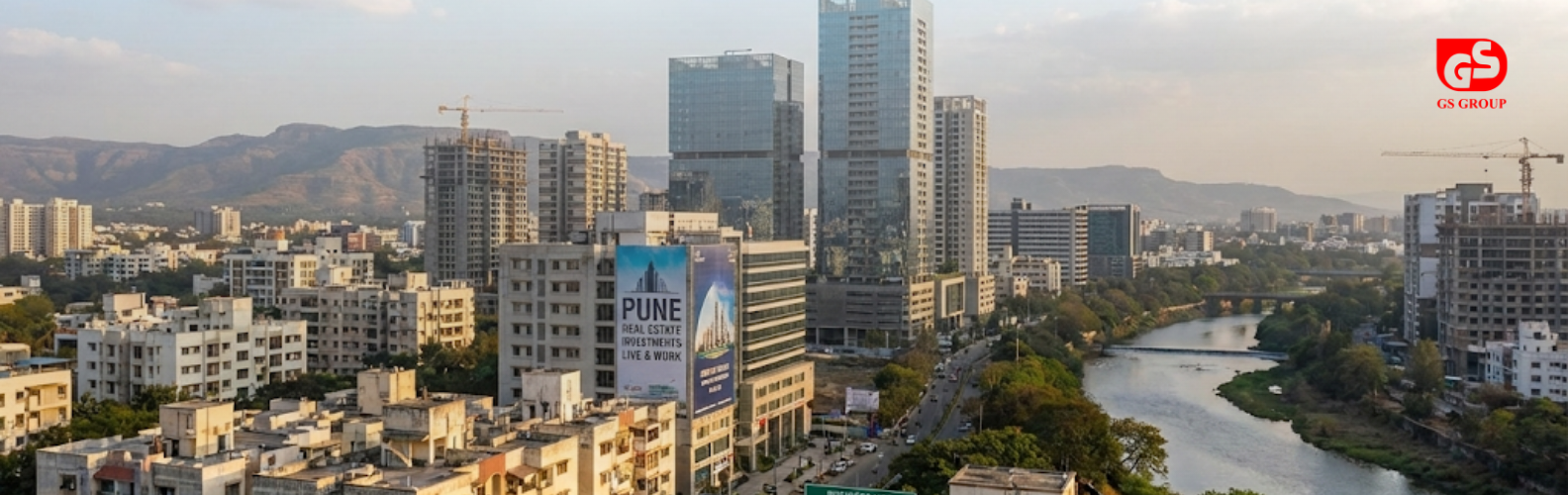
Pune Real Estate Market Trend in 2026
Pune has moved from a “budget alternative to Mumbai” to one of India’s top residential markets, selling around 44,000 homes in just the first half of 2025 and still leading many metros in volume and value. Prices have climbed sharply over the last five years, and by 2026 analysts expect capital values to keep growing by around 5–10 percent per year, which is higher than normal inflation. This makes Pune a value-driven market where people pay more, but also see stronger long-term appreciation.
At the same time, many buyers now feel “sticker shock” because the total cost of a home has grown faster than salaries, pushing typical ticket sizes from about 55 lakh in 2020 to roughly 69 lakh by 2024 and around 75 lakh in 2025. As a result, the typical buyer in 2026 is no longer the very young first-timer alone but more often a mid-career upgrader, a dual-income family, or an investor moving capital from Mumbai, NCR, or overseas.
What is in demand now
Affordable housing under about 45–50 lakh has shrunk to less than roughly one-fifth to one-fourth of new supply, because rising land and construction costs make it hard for developers to offer low-ticket homes with good amenities. Instead, the mid-segment between 50 lakh and 1 crore has become the backbone of the city, forming close to 60 percent of new projects in late 2025 and likely staying dominant in 2026. This band mainly serves IT staff and manufacturing professionals who want gated communities, security, and lifestyle features, not just bare buildings.
There is also a big jump in premium and luxury homes above 1 crore, where sales in the 1–2 crore range have grown fast thanks to senior executives, NRIs, and Mumbai buyers who find Pune’s larger 3 and 4 BHK apartments more spacious and better value. These customers look for larger floor plans, work-from-home space, and green features like solar power and rainwater harvesting, which are now common in newer projects in areas like Baner and Kharadi.
Historical data indicates a consistent upward trend. With land prices rising and inventory in prime locations tightening, the average per-square-foot rate is projected to breach the ₹8,000 mark by 2026. The “Aggressive Upgrading” trend means higher entry points but better long-term asset value.
A critical shift is underway in Pune’s housing inventory. Rising input costs have pushed developers to move away from the sub-₹45 lakh segment, reshaping the market landscape. Today, the city’s supply is increasingly dominated by Premium (₹1 Cr+) and Mid-High projects, designed to attract IT professionals and NRIs who prioritize lifestyle amenities.
Impact on Buyers:
Entry-level buyers may find themselves exploring emerging peripheral locations where affordability is still viable.
Luxury investors, on the other hand, can anticipate access to higher-quality assets and stronger tenant profiles, making the premium segment more attractive for long-term returns.
Market Supply Composition
How different zones are trending
The top premium belt in West Pune includes Baner and Balewadi, where capital values range roughly between ₹9,000 and ₹13,000 per sq ft and ticket sizes for a 2 BHK often touch or cross ₹90 lakh–₹1.2 crore. These locations behave like lifestyle high streets with branded cafes, offices, and redevelopment-driven projects, and suit upgraders and HNI buyers who value image and convenience as much as return.
For buyers who want similar connectivity but at a lower entry point, the natural alternatives are Wakad and Tathawade, which act as spillover markets for Baner–Balewadi and Hinjewadi. Here, prices usually sit around ₹8,500–₹11,500 per sq ft in many projects, but you still get access to the same IT job belt, the Mumbai–Pune Expressway, and the upcoming Metro Line 3, with residential yields in the 3.7–4.3 percent band. On the east side, premium buyers look at Kharadi, Koregaon Park, and Kalyani Nagar for high-end living and strong rentals, while Wagholi and parts of Keshnand/Bakori Road give a more affordable path into the same catchment.
Premium vs mid alternatives
| Segment type | Premium pockets | Nearby mid/value alternatives | Why these alternatives work |
|---|---|---|---|
| West high street | Baner, Balewadi | Wakad, Tathawade, Punawale | Same IT belt, lower ticket size, 3.7–4.3% yields |
| West IT lifestyle | Hinjewadi core | Hinjewadi Phase 2–3, Marunji side, Wakad | Slightly outer but strong rental demand from tech crowd |
| East premium IT | Kharadi, Magarpatta, Koregaon Park/Kalyani Nagar | Wagholi, Keshavnagar–Mundhwa | IT job access and airport connectivity at mid-range prices |
| Central upscale | Boat Club Road, SB Road, Model Colony | Bavdhan, Pashan, Warje corridor | Better value per sq ft but still central-west connected |
Affordable segment across Pune
True affordability has moved to the outer rings and PCMC, where land prices are still workable and infrastructure upgrades like the ring road and metro extensions can unlock future upside. On the north and PCMC side, areas such as Moshi, Charholi, Chikhali, Punawale, Ravet, and Kiwale stand out as affordable or lower-mid belts where entry prices for 2 BHKs are much lower than Baner or Kharadi but annual gains can touch about 10–15 percent due to the industrial Chakan–Talegaon belt and expressway access.
In the east and south-east, Wagholi (core and extended), Hadapsar fringe, Undri–Pisoli–Mohammedwadi, and Uruli Kanchan side of the ring road make up important budget clusters tied to IT and manufacturing jobs. These areas offer lower ticket sizes but require careful checks on water supply, civic infrastructure, and tax norms in merged villages, because tanker dependency and policy uncertainty can affect long-term costs and resale values.
Affordable belts and buyer fit
| Segment | Key affordable / budget belts | Typical buyer profile & use case |
|---|---|---|
| North / PCMC | Moshi, Charholi, Chikhali, Punawale, Ravet, Kiwale | First-time buyers, industrial staff, investors targeting 3–4% rental yields |
| East / South-East | Wagholi, Hadapsar fringe, Undri–Pisoli, Uruli ring-road | Budget-conscious IT workers, long-term infra-growth investors |
| West outer | Pirangut, Bhugaon/Bhukum off ring-road | Price-sensitive buyers who still want west connectivity and future appreciation |
Price & ROI Potential by Zone
Role of metro, ring road, and airport
Infrastructure is the biggest driver of real estate values in Pune going into 2026, even more than in many other Tier-1 cities, because the city historically lacked strong public transport. The Hinjewadi–Shivajinagar Metro Line 3, targeted around 2026, is set to cut commute time from up to two hours to about forty minutes and create a clear “metro premium” around stations. Data from recent years already shows that homes within about 500 meters of metro stops in Pune can see 15–20 percent appreciation over two years, versus 8–10 percent a few kilometres away.
Newly approved Metro Lines 4 and 4A will connect Kharadi, Hadapsar, Swargate, Khadakwasla, and Warje/Manik Baug, effectively tying east and west into a single transit grid and adding 31.6 kilometres of new route. As work progresses, areas along Solapur Road and Sinhagad Road are expected to get a 10–15 percent uplift over the project lifecycle, especially for projects that are truly “walk-to-metro.” For an investor, this means shortlisting projects mapped closely to upcoming stations rather than just believing generic “metro connectivity” claims in brochures.
The Pune Ring Road will open up outer belts like extended Wagholi, Uruli Kanchan, and Pirangut by diverting heavy traffic away from the city core, making long-distance suburbs feel closer in daily life. Reports suggest land and property along this corridor could see 20–25 percent appreciation as the road takes shape and new nodes form at junctions. Further south, the Purandar International Airport, with land acquisition expected to start around late 2025 and operations targeted toward the end of the decade, is already triggering speculative interest in the Purandar–Saswad belt and tightening rules on illegal plotting.
Rental yields, risks, and tips for 2026
On the rental side, Pune continues to offer better yields than Mumbai, where typical apartments earn around 2.5 percent annually, while Pune’s residential yields range near 3–4 percent and commercial offices in zones like Baner and Kharadi can touch 7–9 percent. Rents rose roughly 7–9 percent in early 2025, with 2 BHK flats in Hinjewadi Phase 3 fetching about ₹22,000–28,000 per month and very low vacancy, a pattern likely to continue into 2026 as more staff return to office.
However, there are real risks that a buyer must respect. Water scarcity is a serious problem in parts of East Pune such as Kharadi, Keshavnagar, and Wagholi, where many societies depend on expensive tanker water despite paying high property taxes. In merged villages around PMC limits, property tax rules remain in flux, with collections paused and resumed in phases, creating uncertainty for owners who feel they pay city-level taxes but still live with semi-rural infrastructure.
If you look at the big picture, Pune is shifting from “cheap and growing fast” to “priced higher but growing smarter,” with micro-markets linked to IT jobs and transport seeing the strongest gains. For a 2026 buyer or investor, it makes sense to: focus on mid-segment projects near planned or operational metro lines, check water supply and municipal status carefully, and treat Pune as a long-term, five-to-ten-year hold rather than a quick flip market.
Read More
Upcoming Affordable Areas in Pune 2026
Discover top upcoming affordable areas in Pune 2026 like Wagholi,...
Read MoreKey Tax Benefits On Your First Property Purchase
Discover the Key Tax Benefits On Your First Property Purchase...
Read MoreWagholi High Street Unveils “Deals Ka Tyohar”
Celebrate business growth at Wagholi High Street with GS Group’s...
Read More