
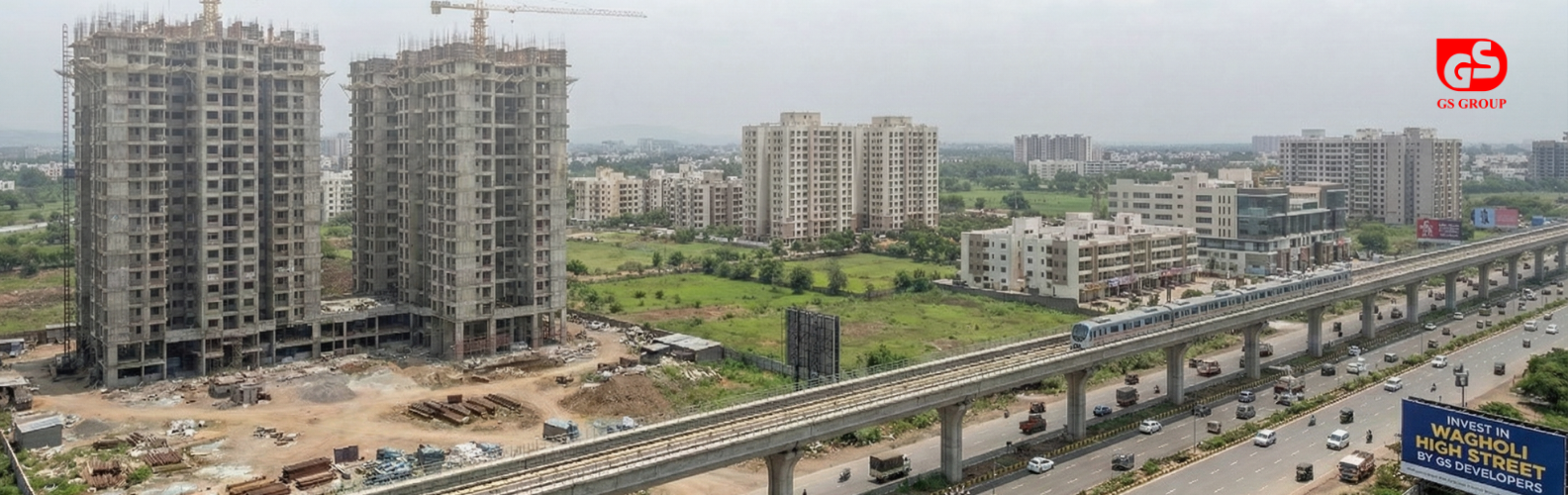
Why Wagholi’s Rental Yield Outpaces West Pune
Wagholi delivers higher rental yield than most established West Pune micro-markets because its entry prices are lower, rental demand is rising faster, and a powerful pipeline of infrastructure is still not fully priced into current property values. While Baner–Balewadi may command higher absolute rents, the percentage return on each rupee invested is often stronger in Wagholi, creating a “yield sweet spot” for investors.
From Premium West To High-Yield East
Over the last decade, West Pune corridors like Baner, Balewadi, and Wakad matured around Hinjewadi IT Park, pushing capital values to the 10,000–14,000 per sq. ft. range for many residential projects. In contrast, Wagholi has evolved from a peripheral village into a fast-growing suburb with average prices still around 6,500–7,000 per sq. ft., keeping ticket sizes accessible while demand scales up.
This maturity gap creates very different investment profiles. In West Pune, investors pay near-peak prices for stable but compressed yields, while Wagholi still trades at “pre-infrastructure” rates with room for both rent and prices to climb together.
The Yield Sweet Spot: Numbers That Matter
Recent data places Wagholi’s average gross residential rental yield around 4.3 to 5 %, supported by 2BHK ticket sizes near ₹60–65 lakh and typical rents in the ₹22,000–₹25,000 per month band. Baner’s 2BHKs often cost upward of ₹1 crore with average rents of about ₹32,000, translating to roughly 3.0 to 3.8 % yield despite its premium positioning.
Research also shows a sharp divergence in Wagholi itself: rental values have grown by about 60–69 percent over the last three to four years, while capital appreciation has trailed closer to 35–40 percent. This gap indicates that rents are repricing faster than property values, a classic signal of an underpriced, high-yield market where the price‑to‑rent ratio still favours landlords.
Rental Yield Snapshot: Wagholi vs West Pune
| Metric (Typical 2BHK) | Wagholi (East Pune) | Baner / Balewadi (West Pune) |
|---|---|---|
| Avg capital value (₹/sq. ft.) | 6,500–7,000 | 10,000–11,200 |
| Approx ticket size | ₹58–65 Lakh | ~₹1.0 Crore |
| Typical monthly rent | ₹22K–25K | ~₹32K |
| Gross rental yield (range) | 4.3–5.0% | 3.0–3.8% |
| 3–4 year rental growth | ~60–69% | Moderate, below price growth |
| Entry barrier | Low–moderate | High |
Who Rents In Wagholi (And Why It Matters)
Wagholi’s yield advantage is powered by three overlapping tenant streams that keep vacancy risk low. Educational institutions like G.H. Raisoni, JSPM, and Moze College create a strong student and PG market, where per-bed rentals can push effective yields well above family leases. At the same time, thousands of junior and mid-level professionals working in EON IT Park and World Trade Center Kharadi choose Wagholi for more space at a lower rent while staying within a 15–20 minute commute.
Further east, industrial hubs in Sanaswadi, Shikrapur, and Ranjangaon add a third layer of demand from managers and engineers seeking better schools and gated societies than the pure industrial belts can offer. This mix—students, “bachelor economy” tenants, and nuclear families linked to IT and industry—supports fast re-leasing and sustained rent escalation, which is harder to replicate in older, more family-only micro-markets in the West.
Wagholi has seen a sharper uptick in rental ask prices over the last 3 years compared to the stabilized West Pune markets.
Infrastructure Super-Cycle Favouring Yield And Future Upside
The reason Wagholi’s yields are strong today—but still likely to compress upward in price later—is the scale of infrastructure being built around it. The Pune Ring Road’s eastern alignment and the Kesnand/Lonikand–Shirur elevated corridor are set to pull heavy traffic off Nagar Road and plug Wagholi directly into major highways and the proposed Purandar airport corridor. Parallelly, the approved Ramwadi–Wagholi Metro extension along the Aqua Line will connect Wagholi to Kalyani Nagar, Viman Nagar, and city cores, typically adding a 15–20 percent “transit premium” near stations over time.
On top of mobility, the Bhama Askhed water supply scheme and Wagholi’s integration into PMC promise more reliable 24×7 piped water, which improves livability and reduces society costs previously inflated by tanker dependence. Together, these upgrades mean current yields are essentially “pre-infrastructure” returns—investors are earning higher income today for taking on a locality where some future benefits are not fully priced in yet.
We mapped Pune’s micro-markets based on two critical factors for investors: Property Price vs. Proximity to Major Job Hubs.
Wagholi occupies the “Opportunity Zone” — Low Price, High Connectivity. In contrast, West Pune markets are in the “Premium Zone” where ROI diminishes.
Why West Pune Lags On Percentage Returns
West Pune continues to be a lifestyle and appreciation favourite, but that strength comes with trade-offs. Property prices in Baner–Balewadi have already priced in years of IT-led growth, premium schools, and malls, so every extra rupee of rent adds relatively less to percentage yield. Meanwhile, intense supply competition in segments like Wakad and Hinjewadi gives tenants more bargaining power, slowing rent escalation even when occupancy remains healthy.
In simple terms, many West Pune investors today are primarily betting on long-term capital appreciation and brand perception, whereas Wagholi investors are combining meaningful appreciation prospects with stronger day-one monthly cash flow. For a yield-focused or SIP-style property investor, this balance of lower entry cost, diversified tenant base, and visible infra-led upside makes Wagholi mathematically more efficient than most West-based alternatives.
How Commercial And High-Street Retail Amplify Returns
Residential yields in Wagholi are already competitive, but organised commercial development is starting to push the ecosystem closer to a “live–work–shop” model. High-street formats like Wagholi High‑Street bring shops, showrooms, and offices into a single, walkable campus, attracting brands that follow rising local consumption. As more residents choose Wagholi for its value and connectivity, this walk-to-retail convenience allows landlords in nearby residential and commercial assets to command a reasonable rent premium.
Across Pune, quality commercial spaces commonly achieve yields between 6–10 percent, higher than typical residential returns, especially in corridors aligned with metro and ring road expansions. For investors, blending a 4.3–5 percent residential asset in Wagholi with a higher-yield commercial unit near upcoming station nodes or ring road feeders can create a more balanced, income-heavy portfolio anchored in the same growth story.
Read More
The Tax Benefits of Investing in Commercial Properties for Salaried Professionals
Unlock the hidden tax advantages of commercial real estate. We...
Read MoreWhy Wagholi’s Rental Yield Outpaces West Pune
Wagholi delivers higher rental yield than most established West Pune...
Read MorePune Real Estate Market Trend in 2026
pune real estate premium hubs, nearby mid-range alternatives, and affordable...
Read MoreThe Commercial Game Changer: Wagholi High Street
While residential yields are attractive, Commercial properties (Retail & SOHO) in emerging hubs like Wagholi often outperform established markets.
Wagholi High Street introduces the concept of integrated retail and office spaces, catering to the growing density of the area.
- ✔ High Street Retail Visibility
- ✔ Appreciation potential aligned with Solapur Highway link